
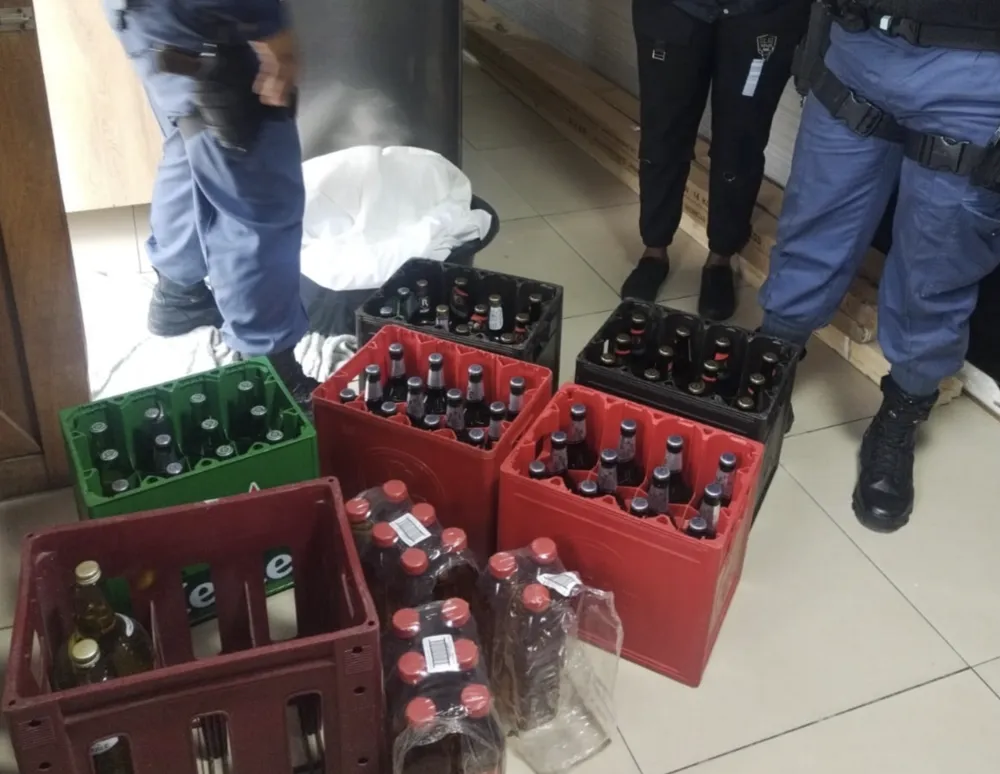
369. That is the number of unlicensed liquor outlets South African police say were closed in a single week, from 21 to 27 September. During the same period, officers carried out 5,727 compliance inspections at licensed establishments and confiscated more than 22,000 litres of alcohol. There were also 1,196 arrests for driving under the influence.
For an industry accustomed to measuring itself in cases, litres, market share and rand value, these are numbers worth paying attention to.
They signal that South Africa’s alcohol story is moving beyond what happens at the cash register and into a more fundamental question: who is allowed to sell the drink, where, when and under what conditions?
That question became considerably more urgent this week.
Following a series of violent incidents, including two separate shootings at drinking venues in Gauteng and the Western Cape that left 28 people dead, President Cyril Ramaphosa directed provincial and municipal authorities to intensify enforcement of existing liquor laws, particularly against unlicensed outlets and establishments operating outside permitted hours. He also instructed the trade, health, social development, police and co-operative governance ministers to prepare a coordinated legislative and enforcement package on alcohol-related violence within 60 days.
The distinction matters.
The government has not said that alcohol itself causes gender-based violence. In his 29 September address, Ramaphosa explicitly said responsibility lies with perpetrators while describing harmful alcohol use as an aggravating factor in interpersonal violence.
For the legitimate drinks industry, that distinction is important because the policy response is not simply an argument about whether South Africans should drink less. It is increasingly an argument about how alcohol is sold.
And that puts the spotlight directly on the enormous gap between the formal market and the informal one.
A licensed bottle store, supermarket, restaurant, bar or tavern operates under a set of rules governing trading hours, licensing conditions and compliance. An unlicensed outlet does not necessarily carry those same costs or constraints. That creates an uneven commercial field before a single beer, bottle of whisky or litre of wine reaches the consumer.
The more aggressively authorities enforce those rules, the more visible that difference becomes.
It is tempting to think of the 369 closures as a policing statistic. For beverage companies, distributors and retailers, they are also a route-to-market statistic.
A producer can spend heavily on packaging, refrigeration, sales teams, promotions and brand building, only for its products to enter an environment where the rules governing the final point of sale are inconsistent. That makes market development harder to measure and harder to control.
The formal industry has a direct interest in changing that equation.
This is especially relevant at the lower end of the market, where price competition is fierce and where every additional cost matters. Excise duty, logistics, electricity, rent, refrigeration and compliance all have to be absorbed somewhere. An unlicensed seller operating outside the same regulatory framework can have a very different cost base.
That does not mean every informal outlet is involved in criminal activity, nor does it mean every licensed outlet is compliant. The police data itself makes the point: thousands of inspections were conducted at licensed establishments during the same week. Compliance is not a binary formal-versus-illicit story.
It is a spectrum.
And the industry may now have to engage with that reality more directly.
The policy pressure is not appearing in isolation. In its 2026 State of the Nation Address, the government had already identified alcohol as a high-risk sector in the fight against the illicit economy, saying data analytics and artificial intelligence would be used to target illegal and counterfeit activity in alcohol alongside other sectors. The government has also previously proposed measures including tighter controls on outlet density and trading hours, while the 2026 draft tax legislation included changes to alcohol excise duties.
What has changed this week is the urgency.
The President’s new instruction places enforcement and legislation on a clock: 60 days for the coordinated package, followed by public reporting on implementation.
That could change the conversation inside beverage companies.
For years, responsible-drinking programmes have often sat in the corporate affairs or marketing side of the business. The latest developments suggest that responsible retailing, outlet monitoring and channel integrity may increasingly belong in the commercial
conversation as well.
Who sells your brand matters.
Where it is sold matters.
Whether the retailer is properly licensed may matter even more.
There is also a geographical dimension. The Southern African Alcohol Policy Alliance in South Africa has called for authorities to examine liquor outlet density, zoning, licensing status, operating hours and compliance, particularly where outlets operate close to homes, schools and other community facilities. SAAPA SA has also argued that licensing needs to be accompanied by effective monitoring and mechanisms to reconsider licences where establishments repeatedly fail to comply.
Those are proposals from an advocacy organisation, not settled government policy. But they show where the debate could head next.
And that is potentially more disruptive than another incremental increase in the price of a bottle.
If licensing becomes more tightly enforced, the commercial map of alcohol could change. Some outlets may close. Some trading hours could become less attractive. Some distributors may have to reconsider customer portfolios. Brands with strong presence in informal channels could face greater scrutiny, while compliant retailers may gain additional relevance.
The effects would not be confined to alcohol companies.
Hospitality businesses, convenience stores, event venues, restaurants and transport-linked retailers all depend on the ability to sell drinks in a predictable regulatory environment. The health of that environment affects everything from a Friday-night beer to a premium bottle opened at a city restaurant.
There is another issue hiding underneath all of this: substitution.
If an unlicensed outlet closes, consumers do not automatically stop consuming alcohol. Some will move to licensed retailers. Others may shift to different products, different occasions or different channels. That makes the eventual economic effect of enforcement much harder to predict than the number of closures suggests.
It also means the formal industry will need better data.
The most useful question is no longer simply how much alcohol South Africans consume. It is where they buy it, what kinds of outlets they use, how frequently those outlets comply, how close they are to sensitive community locations and how purchasing behaviour changes when availability shifts.
South Africa is entering October with an unusually clear set of signals: more enforcement, a government deadline, renewed scrutiny of liquor outlets and a formal industry that already operates under significant tax and compliance costs.
The next 60 days will show whether the response becomes another policy announcement or the beginning of a materially different alcohol retail system.
For the drinks industry, the most valuable bottle on the shelf may soon be the one sold through the right door.
Comments
One response to “369 Liquor Outlets Closed. South Africa’s Alcohol Trade Enters a 60-Day Reckoning”
[…] is currently hurtling through a period of intense structural recalibration. From the recent closure of hundreds of unlicensed liquor outlets and the premiumisation wave sweeping local brandy to anxious monitoring of El Niño weather […]